R&D Credits

Software Development R&D Credits Built on Specific Project Narratives

Software R&D claims are scrutinized when they describe product roadmaps instead of technical uncertainty. A defensible file focuses on architecture, algorithms, integration constraints, scalability, security, testing, wage nexus, and internal-use software classification.

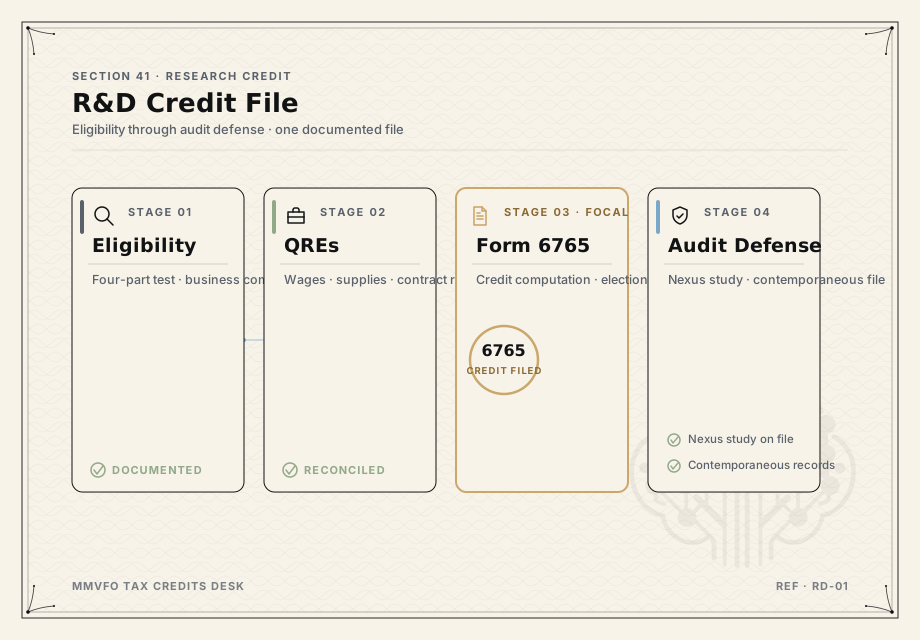
Defensible R&D credit file with eligibility, QRE, Form 6765, and examination support layers

R&D Credits

Defensible credit file

R&D credit work is visualized as a file, not a claim: eligibility, QRE support, Form 6765, and examination readiness.

What a defensible R&D credit file requires

R&D work is treated as a tax position: Section 41 eligibility, business components, QREs, Form 6765, Section 174A/280C, and examination readiness have to fit together.

Eligibility

Four-part test discipline

Permitted purpose, technological nature, technical uncertainty, experimentation, and business-component support are reviewed before the claim is calculated.

Return

Form 6765 and 174A/280C

Calculations and narratives are connected to current Form 6765 reporting, domestic and foreign R&E treatment, and Section 280C decisions.

Defense

Examination file first

Records, workpapers, technical narratives, employee and contractor support, and response posture are organized before questions arise.

Operating standard

  • Documentation comes first, so credit positions can be reviewed, supported, and defended.
  • Connect software, startup payroll-tax-offset, Form 6765 Section G, Section 174A/280C, state R&D, and audit-defense pages.
  • Support advisor co-advisory and CPA-firm workflows.
  • Keep the page focused on substantiated R&D positions, technical records, and measured professional review.

Who this serves

Software companies, SaaS businesses, product teams, startups, engineering-led manufacturers, internal platform teams, and CPA firms reviewing software-related R&D claims.

Common risks

Software claims can be vulnerable when narratives are generic, tickets are not connected to technical uncertainty, wage allocations are unsupported, or internal-use software rules are ignored.

MMVFO process

MMVFO coordinates technical interviews, repository and ticket review, business-component mapping, QRE support, internal-use screening, and professional review of the claim file.

Evidence trail

Tickets, code review records, architecture documents, design reviews, test plans, sprint notes, release notes, security logs, and incident records may help support the facts.

Return coordination

Software R&D work should align with Form 6765, Section 174A, contractor treatment, cloud cost review, payroll offset elections, and audit defense records.

Scope and professional boundaries

FAQs

No. Qualification depends on technical uncertainty, experimentation, business component, permitted purpose, and documentation.
They can be useful when tied to qualified activities, employee roles, technical uncertainty, and cost support.
It is software developed primarily for internal functions and may be subject to special rules that require fact-specific analysis.
Potentially, including through the payroll tax offset if eligibility, documentation, and election requirements are met.

Request a Private Tax Strategy Diagnostic

If your tax, entity, investment, estate, insurance, or reporting picture has become too complex for one advisor to see clearly, MMVFO can help map the moving parts.

Request Diagnostic

Reviewed by Joshua V. Azran, CPA/ABV/CFF, CMA, CGMA, CFE and Lorenzo Abbatiello, CPA | Last updated