
For Advisors
One desk, one record
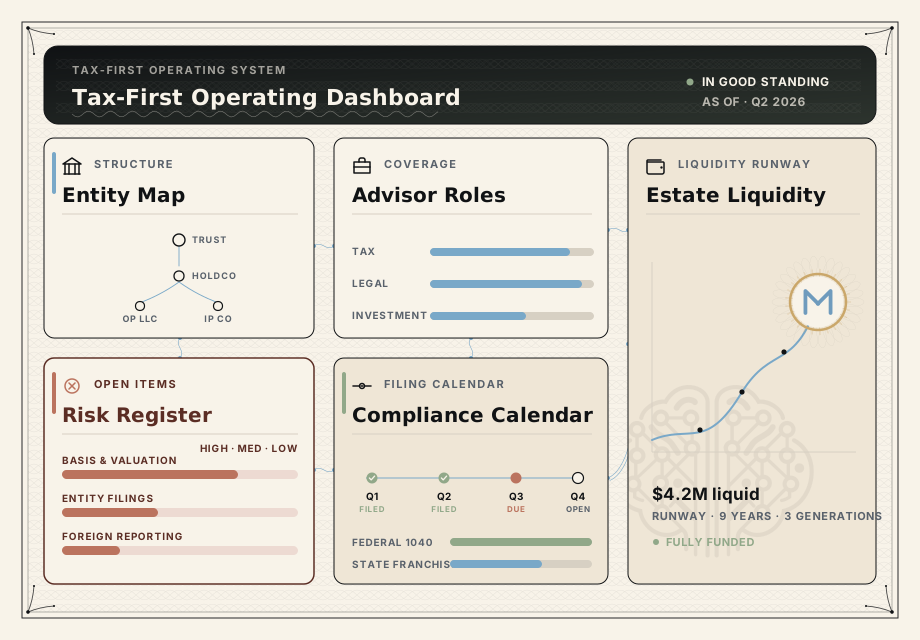
Complex wealth needs an operating cadence across entities, advisors, filing calendars, estate liquidity, and risk review.
What a family office tax desk does
A family office tax desk is a standing coordination function for the tax side of a complex family. It logs, classifies, sequences, documents, and routes tax-sensitive questions to the right professional before they become return positions, so each specialist lane stays visible to the others.
Who this is for
- CPA firms whose clients’ structures have outgrown a single preparer’s view
- RIAs and planners whose clients raise tax questions outside the engagement
- Estate attorneys who want structures administered as drafted
- Trustees and insurance professionals responsible for distributions, policies, and records
- Family office staff, controllers, and family decision-makers who want one view
Why tax work fragments inside complex families
Fragmentation is structural, not a competence problem. Each advisor is hired for one lane and usually runs it well; the failures live between the lanes, on three axes.
Facts drift from documents
A structure holds up only if the facts underneath it stay real and recorded: actual transfers, arm’s-length terms, books that match what happened. When no one owns the file, facts and paperwork quietly separate.
Sequence decides outcomes
Some moves only work before a transaction ripens, and some allocations and elections are measured on specific dates. A step executed in the wrong order can cancel the benefit of the step before it.
Each advisor optimizes one line
Trust drafting, return positions, insurance ownership, and valuation support can pull against each other when no shared record connects them.
The patterns are familiar: a trust drafted on one set of tax assumptions while returns are prepared on another; a policy bought personally and moved into a trust that could have owned it from the start; an exemption allocation measured on an appreciated value because two calendars were never connected. That is what separate files produce.
Core tax desk functions
Issue intake and classification
Each question gets an owner, a deadline, and a rough exposure estimate before anyone acts on it.
Entity and ownership map
Entities, classifications, ownership, basis records, and K-1 flows in one current view.
Tax calendar
Returns, extensions, estimates, K-1 delivery, trust and gift filings, entity renewals, and planning windows.
Documentation control
Which records must exist, where they live, and what supports each filed position.
Specialist routing
R&D files, international reporting, valuation, state, and controversy matters routed to the right lane.
Decision log
What was decided, on which facts, who owned it, and the next review date.
MMVFO coordinates tax-led diagnostics, planning context, documentation, advisor alignment, and implementation routing. Insurance implementation, investment advisory services, financial planning, securities-related services, legal services, and other regulated services are provided only by properly licensed or registered affiliates, unaffiliated professionals, or a client’s existing advisors under written scope and applicable disclosures. Public website content is educational and does not create client-specific tax, legal, investment, insurance, accounting, fiduciary, or other professional advice. Advisor matters also require client authorization where required, confidentiality review, professional responsibility review, and referral or compensation disclosures where applicable.
Coordination with existing advisors
The default assumption is that incumbent advisors stay. The desk maps what the team already covers, finds the gaps, and fills them precisely. Advisor engagements run through the Advisor Partner Hub and B2B tax advisory services under clear ground rules:
- Written scope before any work begins, with deliverable ownership stated up front.
- Client authorization where required, confidentiality review, professional responsibility review, and referral or compensation disclosures where applicable.
- A communication protocol: who is copied, who decides, who documents, who follows up.
- Existing roles preserved: the CPA signs the return, the attorney drafts, the registered adviser advises, the desk keeps the record.
- Escalation triggers for transactions, notices, and deadline conflicts.
The tax calendar and documentation map
The calendar is the desk’s operating spine. One view holds return and extension deadlines, estimates, K-1 delivery timing, trust distribution windows, gift and estate filings, entity renewals, and year-end planning windows, so nothing reaches the preparer for the first time in April.
Documentation is not clerical. For example, a large gift reported on a complete gift tax return (Form 709) with a qualified appraisal or a detailed description of the valuation method starts a limited assessment window, generally three years. Reported incompletely, the same gift can stay open to examination indefinitely. The difference is the file, not the strategy.
Documents and facts worth reviewing
- Recent returns with K-1s, state filings, and carryforward schedules
- Gift and estate filings with their valuation support
- Trust instruments, amendments, and trustee records
- Operating agreements, ownership ledgers, and basis records
- Qualified appraisals and the data behind claimed discounts
- Insurance policy schedules and ownership history
- Notice history, prior examinations, and statute extension consents
- Intra-family and entity-level loan documents
Controversy readiness
Controversy readiness means the file exists before anyone asks for it. Examination outcomes tend to track the contemporaneous record, and penalty relief often turns on reasonable cause and good faith, built in advance through documented reliance on qualified professionals and appraisals, not assembled after a notice arrives.
The desk keeps the notice chronology current, tracks assessment windows instead of assuming them, treats any extension of an assessment period as a deliberate choice, and keeps valuation and disclosure files complete. Representation and legal advocacy remain with properly licensed professionals; the desk’s job is that they arrive with a complete file. See IRS notice triage support and IRS audit defense coordination.
Regulated service boundaries
Legal advice, investment advisory services, financial planning, securities-related services, insurance implementation, and other regulated services remain with properly licensed or registered professionals.
Deliverable standards
The desk produces issue lists, document requests, advisor meeting agendas, tax calendars, risk maps, planning-context memos, and next-step summaries under written scope. One rule governs all of them: no decision without a record, no record without an owner, no owner without a next date.
Where engagements start
Advisor teams open a matter through the advisor partner matter intake, which structures facts, documents, and deadlines before the first working session. Families typically start with a private tax strategy diagnostic. The full model behind the desk lives on the tax-led virtual family office overview.