
International Tax
International reporting map
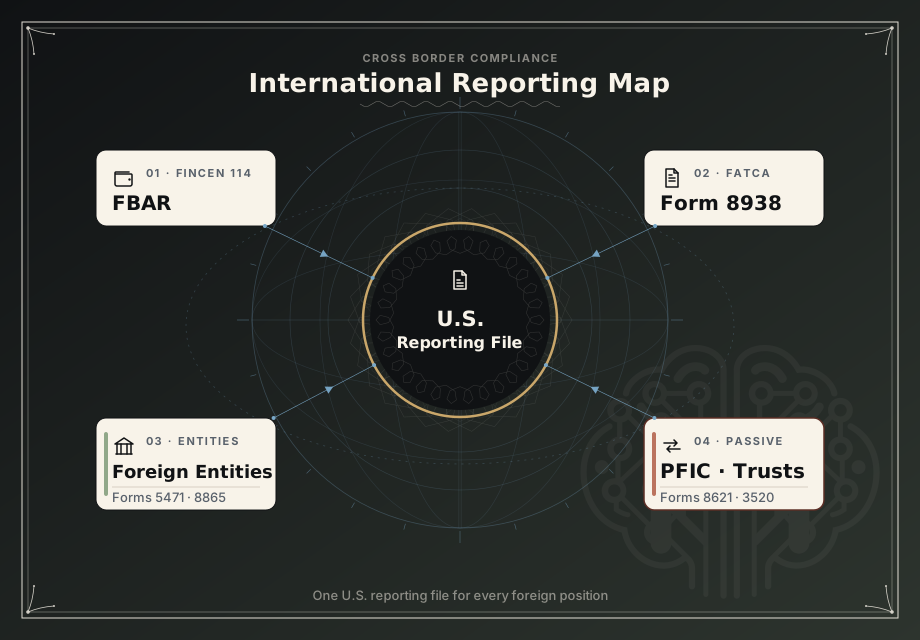
Cross-border work is mapped by accounts, assets, entities, trusts, investments, filing history, and penalty-sensitive facts.
Asset inventory
Identify foreign financial accounts, foreign securities, foreign fund interests, foreign entity interests, debt instruments, pensions, and other specified foreign financial assets.
Threshold review
Coordinate filing status, residence, asset value, year-end value, and maximum value facts before assuming a form is or is not required.
Income reconciliation
Tie reported assets to dividends, interest, capital gains, partnership income, trust distributions, foreign taxes, and currency translation support.
Overlap with other forms
Review how Form 8938 interacts with FBAR, Forms 5471, 5472, 8865, 8858, 3520, 3520-A, and 8621.
Late or inconsistent reporting
Where prior returns omitted assets or income, evaluate penalty exposure and counsel needs before filing amended or corrective returns.
Key reporting differences
FBAR / FinCEN Form 114
FBAR is a Bank Secrecy Act foreign account report filed electronically with FinCEN, not an income tax return form.
- Applies to U.S. persons with a financial interest in, signature authority over, or other authority over foreign financial accounts when the aggregate account value exceeds $10,000 at any time during the calendar year.
- Focuses on foreign financial accounts, including many bank, securities, brokerage, mutual fund, pension, and cash-value insurance accounts.
- Filing is separate from Form 1040 and generally uses FinCEN's BSA E-Filing system.
Form 8938
Form 8938 is an IRS income-tax-return attachment for specified foreign financial assets held by specified individuals and certain domestic entities when applicable thresholds are met.
- Thresholds vary by filing status and whether the taxpayer lives in the United States or abroad.
- Specified foreign financial assets can include foreign accounts, foreign stocks and securities, interests in foreign entities, certain foreign pensions, and certain foreign insurance or annuity contracts.
- Signature authority alone generally is not the same as an ownership interest for Form 8938 purposes.
One filing does not replace the other
Form 8938 and FBAR overlap, but they are separate reporting regimes. A taxpayer may need one, both, or neither depending on the facts.
- Filing Form 8938 does not satisfy an FBAR requirement when FBAR applies.
- The same foreign account can appear in both systems when both thresholds and rules are met.
- Late or missed filings should be triaged before corrective submissions are made.
FBAR vs. Form 8938 comparison
These regimes often overlap, but they are not substitutes for one another.
| Topic | FBAR / FinCEN Form 114 | Form 8938 / FATCA |
|---|---|---|
| Governing system | Bank Secrecy Act report administered through FinCEN. | FATCA-related IRS information return attachment. |
| Primary filing channel | Filed electronically through FinCEN's BSA E-Filing system. | Attached to the taxpayer's annual income tax return. |
| Core threshold | Aggregate foreign financial accounts exceed $10,000 at any time in the calendar year. | Thresholds vary by filing status and residence; for many U.S.-based individual filers, thresholds begin at $50,000 year-end or $75,000 any time. |
| Who is screened | U.S. persons, including individuals and certain domestic entities. | Specified individuals and certain specified domestic entities. |
| What is covered | Foreign financial accounts, including ownership and signature or other authority. | Specified foreign financial assets in which the taxpayer has an interest. |
| Signature authority | Can trigger reporting even without beneficial ownership. | Signature authority alone generally does not create a Form 8938 reporting interest. |
| Deadline framework | Annual FBAR due date follows the April 15 framework with automatic extension mechanics. | Filed with the income tax return, including applicable return extensions. |
| Penalty sensitivity | Late, incomplete, or willful failures can carry significant civil and potential criminal exposure. | Failure to file can create IRS penalties and may interact with omitted income or accuracy-related issues. |
Common asset and account coverage
Coverage depends on the taxpayer, asset, institution, ownership, authority, filing status, residence, and year-specific facts.
| Asset or account | FBAR | Form 8938 |
|---|---|---|
| Foreign bank or deposit account | Generally reportable when the aggregate account threshold and authority/interest rules are met. | Generally included as a specified foreign financial asset if Form 8938 thresholds are met. |
| Foreign brokerage or securities account | Generally treated as a foreign financial account. | Generally treated as a specified foreign financial asset. |
| Foreign mutual fund or pooled foreign investment | May be a foreign financial account depending on how it is held. | Often relevant as a specified foreign financial asset and may also raise PFIC/Form 8621 questions. |
| Signature authority over an employer or entity account | Can be reportable when FBAR rules are met. | Generally not reportable solely because of signature authority without an ownership interest. |
| Interest in a foreign corporation, partnership, or trust | Not reported merely because of the entity interest unless foreign financial accounts are involved. | May be a specified foreign financial asset and can also trigger Forms 5471, 8865, 8858, 3520, or 3520-A. |
| Foreign pension, retirement account, cash-value insurance, or annuity | Often requires FBAR review as a foreign financial account or similar arrangement. | Often requires Form 8938 review as a specified foreign financial asset. |
| Directly held foreign real estate | Direct real estate is not itself a foreign financial account. | Direct foreign real estate generally is not itself a specified foreign financial asset, but entities, accounts, loans, and income around it may matter. |
| Assets also reported on Forms 5471, 8865, 3520, 3520-A, or 8621 | FBAR may still apply to foreign financial accounts even if related forms are filed. | Form 8938 may require cross-reference or coordination with other foreign information returns. |
Diagnostic questions
- Is the taxpayer a specified individual or specified domestic entity with interests in foreign accounts, securities, foreign entity interests, pensions, insurance, annuities, or other specified foreign financial assets?
- What were the year-end and maximum values of specified foreign financial assets, and which Form 8938 threshold applies based on filing status and residence?
- Are any assets already connected to Forms 5471, 8865, 8858, 3520, 3520-A, or 8621, requiring coordinated reporting rather than isolated Form 8938 review?
- Do foreign accounts or assets generate income that must be reconciled to the income tax return, including interest, dividends, gains, foreign taxes, partnership income, or trust distributions?
- Have prior returns omitted foreign assets, foreign income, or related forms in a way that should be reviewed before amendment or late filing?
Documentation and recordkeeping
- Account names, account numbers, financial institution names and addresses, account type, ownership or authority details, and maximum annual value for each foreign financial account.
- Year-end and maximum values for specified foreign financial assets, including currency conversion support and valuation records where needed.
- Foreign entity, partnership, trust, pension, insurance, annuity, and investment documents that may connect Form 8938 with Forms 5471, 8865, 8858, 3520, 3520-A, or 8621.
- Prior-year filings, extensions, amended returns, notices, account opening and closing records, and advisor correspondence, reviewed only through secure intake after written scope.
- A five-year FBAR recordkeeping file for reportable accounts, supported by institution statements or other reliable records.
Official source notes
Scope and professional boundaries
This page is educational and is not tax, legal, accounting, investment, insurance, or other professional advice. Client-specific work requires written scope and review by qualified professionals. Legal representation, privilege, litigation strategy, and regulated services are provided only by properly licensed or registered counsel, affiliates, or other professionals where included in scope. International filings, treaty positions, residency conclusions, voluntary disclosure, willfulness, and penalty remediation may require specialist tax review and qualified counsel. Use public forms only for non-sensitive triage. Do not submit tax returns, notices, account statements, identification documents, privileged communications, or other sensitive records through public forms; secure portal review begins only after qualification and written scope.