
Short answer
What this page answers
Form 6765 Section G readiness depends on business-component records, 80% / Top 50 QRE reporting, wage-role categories, amended-claim support, controlled-group threshold review, Section 280C coordination, and return workpapers that match the claimed credit.
R&D Credits
Defensible credit file
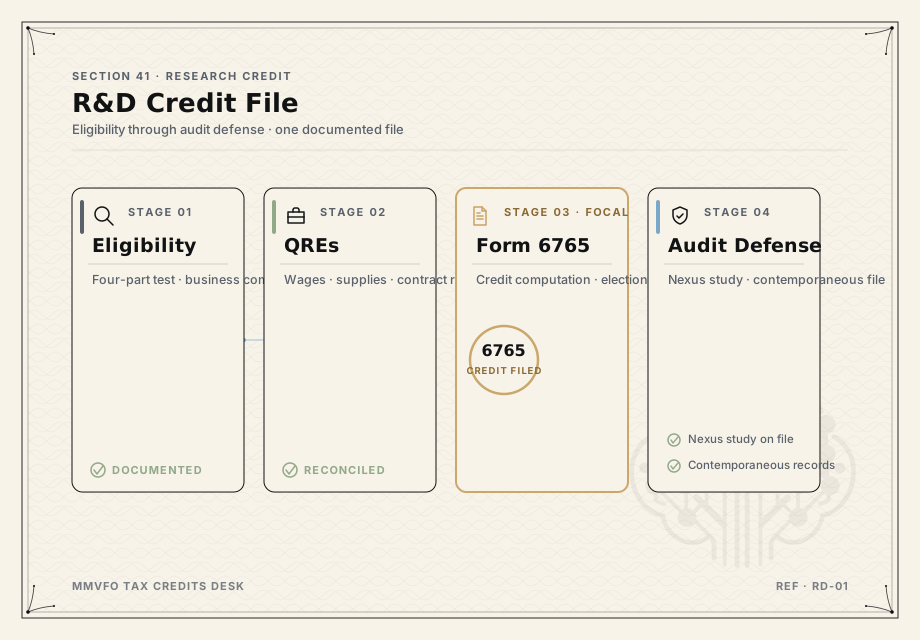
R&D credit work is visualized as a file, not a claim: eligibility, QRE support, Form 6765, and examination readiness.
Effective-date and filing posture
For tax year 2025, Section G is optional for all filers. For tax year 2026 and later, Section G is mandatory for most filers, with optional reporting for qualified small businesses electing the payroll-tax offset and certain small original-return filers. Amended-return refund claims need separate validity review.
Business-component reporting
A Section G-ready file identifies the products, processes, software, techniques, formulas, or inventions tied to the claim, then ranks components by QRE amount until the 80% / Top 50 reporting threshold is addressed.
QRE categories and wage roles
Section G readiness requires more than total QREs. The file should separate direct research wages, direct supervision wages, direct support wages, supplies, contract research, and computer rental or cloud costs where relevant.
Amended-return claims
Research credit refund claims should identify business components, research activities for each component, and total QREs by category before submission. During the transition period through January 10, 2027, deficient claims can receive a 45-day perfection window.
Section 174A and Section 280C coordination
Form 6765 should be reviewed with domestic research expense treatment, foreign research amortization, Section 280C reduced-credit elections, payroll-offset use, state conformity, and controlled-group reporting.
MMVFO readiness process
MMVFO organizes the component registry, documentation checklist, QRE tie-outs, software classification support, amended-claim posture, and preparer-review workflow so the credit file supports the return rather than sitting beside it.
Form 6765 Section G readiness framework
Use 2025 as a readiness year
IRS guidance makes Section G optional for all filers for tax year 2025. For tax year 2026 and later, Section G is mandatory for most R&D credit filers, with narrow optional-reporting categories.
Confirm exemptions at the controlled-group level
Optional reporting can apply to qualified small businesses electing the payroll tax offset and to small original-return filers with no more than $1.5 million of QREs and no more than $50 million of gross receipts at the controlled-group level.
Report the 80% / Top 50 components
Section G requires business-component reporting in descending QRE order until at least 80% of total QREs or 50 components are covered. Remaining components are reported as aggregate business components.
Refund claims have a separate validity workflow
Research credit refund claims on amended returns need business components, research activities for each component, and QRE totals by category. A 45-day perfection transition runs through January 10, 2027.
Coordinate Section 280C and Section 174A
Form 6765 is not only a credit calculation. It also coordinates the reduced-credit election under Section 280C, payroll-tax credit use, controlled-group reporting, and research-expense treatment.
Section G effective-date and filing-status map
The filing year, original-versus-amended posture, and controlled-group profile determine how Section G should be approached.
| Tax period or filing posture | Section G status | Review point | Primary source |
|---|---|---|---|
| Tax years beginning before 2026 | Section G optional for all filers | The new Form 6765 may still be required, so treat 2025 as a dry-run year for business-component reporting. | IRS IR-2025-99 and current Form 6765 instructions |
| Tax years beginning in 2026 and later | Section G mandatory for most filers | Screen for optional-reporting categories before deciding whether Section G must be completed. | IRS IR-2025-99 and current Form 6765 instructions |
| Qualified small business payroll-offset filers | Optional reporting if requirements are met | Confirm qualified small business status and the payroll-tax credit election in Section D. | IRS IR-2025-99 and Form 6765 guidance |
| Small original-return filers | Optional reporting if both thresholds are met | Confirm QREs do not exceed $1.5 million and gross receipts do not exceed $50 million at the controlled-group level. | IRS IR-2025-99 |
| Research credit refund claims on amended returns | Special refund-claim information required | Business components, research activities, and QRE category totals should be complete before submission. | IRS refund-claim guidance and amended-return FAQs |
| Through January 10, 2027 | 45-day perfection transition for deficient refund claims | Monitor IRS notices and response deadlines; deficient claims can be rejected if not perfected. | IRS IR-2025-99 and amended-return FAQs |
Section G optional-reporting categories
Optional reporting should be treated as a professional review item, not a casual size test.
| Category | Who it can fit | Key limits | Review point |
|---|---|---|---|
| QSB payroll-tax offset | Qualified small businesses that elect to use the research credit as a payroll-tax offset. | Status depends on the Section 41(h)(3) qualified small business rules and the Section D payroll-credit election. | Confirm gross receipts history, payroll-offset election mechanics, Section 280C treatment, and Form 8974 workflow. |
| Small original-return filer | Original-return filers with no more than $1.5 million of QREs and no more than $50 million of gross receipts. | Both thresholds are measured at the controlled-group level and the category does not apply to amended-return refund claims. | Aggregate all commonly controlled entities before concluding the taxpayer is within the optional-reporting category. |
| Amended return or refund claim | Taxpayers claiming or increasing a research credit refund on an amended return. | Refund-claim procedures require business components, activities, and QRE category totals regardless of ordinary size shortcuts. | Do not rely on the small original-return category for amended-claim posture without professional review. |
Section G business-component reporting map
A Section G-ready file should connect each reported component to activities, costs, software classification where relevant, and return-level reconciliation.
| Reporting item | What it means | File need |
|---|---|---|
| Business-component registry | Products, processes, software, techniques, formulas, or inventions are identified at the level where qualified research was performed. | Unique component IDs, project owners, claim-year activity, technical uncertainty, and component status. |
| 80% / Top 50 ordering | Components are sorted by QRE amount until at least 80% of total QREs or 50 components are reported. | QRE totals by component, ranking support, and aggregate line support for remaining components. |
| Wage-role categories | Employee QREs are separated into direct research, direct supervision, and direct support categories. | Role summaries, employee rosters, payroll records, time data, allocation method, and reviewer notes. |
| Software classification | Software components may need internal-use, dual-function, excepted, or non-internal-use classification. | Architecture notes, intended users, commercial or third-party interaction facts, and high-threshold review where relevant. |
| Statistical sampling | Sampling may support QRE determinations, but the required business-component reporting still needs careful mapping. | Sampling plan, population definition, sample labels, tie-outs, and review against Rev. Proc. 2011-42. |
| Amended-return support | Refund claims need the business components, research activities, and QRE category totals required by IRS claim-validity guidance. | Claim-year schedules, amended-return explanation, signed declaration, and response plan for any perfection letter. |
Form 6765 Section G documentation readiness checklist
This checklist identifies records to organize before return preparation, amendment, diligence, or controversy support. Sensitive records should move only through a secure portal after written scope.
- Entity and controlled-group profile. EINs, principal business activity codes, entity chart, controlled-group analysis, acquisitions or dispositions, QRE totals, and gross receipts support.
- Business-component identification. Master project list, component type, software classification, shrink-back analysis, 80% / Top 50 schedule, and aggregate-component calculation.
- Four-part test support. Permitted-purpose narrative, technological discipline, uncertainty at project inception, alternatives evaluated, testing method, iterations, and results.
- QRE support by component. Direct research wages, direct supervision wages, direct support wages, supplies, contract research, and computer rental or cloud-cost schedules tied to source records.
- Contractor and funded-research review. Contracts, statements of work, rights terms, risk-of-loss terms, invoices, deliverables, and 65% inclusion support where applicable.
- Statistical sampling support. Sampling plan, population, selection method, sample labels, QRE tie-outs, and confirmation that required components are still reported.
- Amended-return file. Business components, research activities, QRE category totals, claim-year support, response calendar, and 45-day perfection readiness where relevant.
- Return preparation workflow. Form 6765 version check, Section 280C election record, controlled-group attachment, Section E and F tie-outs, Section G draft, and reviewer sign-off.
Amended-return and refund-claim readiness
Amended R&D credit refund claims should be prepared as claim-validity files, not only revised credit calculations.
- Identify every business component to which the Section 41 research credit claim relates for the claim year.
- Describe the research activities performed for each business component, using facts rather than statutory conclusions.
- Provide total qualified wage, supply, and contract research expenses for the claim year.
- Keep the explanation consistent with Form 6765, the amended return, workpapers, and any pass-through reporting.
- Calendar any IRS perfection notice immediately; during the transition period a deficient claim can receive 45 days to cure missing information.
- Use secure intake for returns, payroll, contracts, project records, and prior IRS correspondence after engagement scope is established.
Professional review boundary
Public pages and diagnostics organize facts and route the matter. They do not determine a credit, promise an IRS result, or substitute for professional judgment.
- Do not treat public intake answers as a determination of R&D credit eligibility or QRE amount.
- Do not upload returns, payroll records, contracts, source code, or technical records through public forms.
- Confirm Section G status against current IRS instructions before filing because forms and procedures can change.
- Coordinate any Section 280C election, Section 174A treatment, payroll-offset use, amended-return filing, or state conformity position with qualified professionals.
- Use workflow tools to organize records; final conclusions require qualified professional review under written scope.
Diagnostic questions
- What tax year or years are being prepared, reviewed, amended, or defended?
- Is the credit being claimed on an original return or an amended return seeking a refund?
- Has the taxpayer previously claimed the R&D credit, and for which years?
- Is the taxpayer using the regular credit or the alternative simplified credit?
- Has a Section 280C reduced-credit election been made or considered for the year?
- Is the taxpayer part of a controlled group or group under common control?
- How many entities are in the controlled group, and have QREs and gross receipts been calculated at the group level?
- What are current-year gross receipts and average annual gross receipts for the prior three tax years?
- What are total QREs for the claim year at the controlled-group level?
- Did the taxpayer acquire or dispose of a major portion of a trade or business during the year?
- Does the company maintain a formal project list or R&D project registry?
- How are qualifying activities categorized by product, process, software, technique, formula, or invention?
- Can the company identify the top projects representing 80% of total QREs, and how many projects is that?
- For software projects, has each project been classified as internal-use, dual-function, excepted, or non-internal-use?
- Has a shrink-back analysis been applied to identify the most specific qualifying business component?
- Are employee wages tracked at the individual level and linked to specific projects?
- Can direct research, direct supervision, and direct support wages be separated by component?
- Are supply expenditures tracked by project, component, or only in aggregate?
- Have contract research arrangements been reviewed for funded-research issues and allowable inclusion percentage?
- Are computer rental, cloud, or hosted-development costs included, and are they linked to qualifying activities?
- Has statistical sampling been used or considered for QRE determination?
- Can required business components still be reported individually if sampling is used?
- For an amended return, does the claim include business components, research activities, and QRE category totals?
- Has the IRS issued a deficient-claim notice, and what is the response deadline?
- Is the amended return or claim postmarked after June 18, 2024?
- Has the R&D credit claim ever been examined by the IRS?
- If examined, what issues were raised and were any concessions made?
- Are there outstanding information document requests or notices related to the research credit?
Official source notes
Scope and professional boundaries
This page is educational and does not determine credit eligibility, calculate a credit, or provide tax, legal, accounting, investment, insurance, or other professional advice. Credit work requires written scope, qualified professional review, and coordination with affiliates or outside specialists when the matter requires specialized technical support. Public intake and website content do not determine R&D credit eligibility, QRE amounts, Section G filing status, refund-claim validity, or examination outcomes. Sensitive returns, payroll-tax records, contracts, and technical files should be shared only through a secure portal after written scope.
MMVFO coordinates strategy, diagnostics, documentation, and advisory execution. Legal, investment advisory, financial planning, securities-related, insurance, and other regulated services are provided only by properly licensed or registered professionals under appropriate written terms.