
Short answer
What this page answers
Section 174A and Section 280C coordination should be reviewed with the R&D credit, Form 6765 reporting, domestic and foreign research expense treatment, state conformity, and return workpapers before filing.
R&D Credits
Defensible credit file
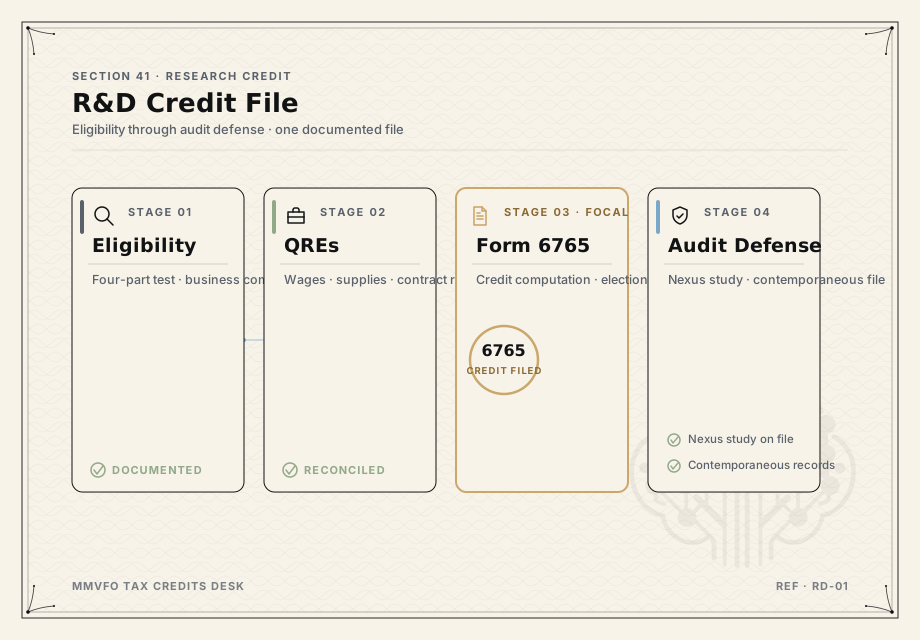
R&D credit work is visualized as a file, not a claim: eligibility, QRE support, Form 6765, and examination readiness.
Who this serves
Companies with domestic or foreign R&E costs, startups using the payroll-tax offset, CPA firms, CFOs, controllers, tax departments, and advisor teams coordinating research expense deductions with R&D credit claims.
Common risks
Taxpayers can create mismatches when domestic R&E deductions, foreign amortization, Section 41 QREs, Form 6765, Section 280C elections, state conformity, and prior-year transition rules are reviewed separately.
MMVFO process
MMVFO builds a domestic-vs-foreign R&E map, coordinates the R&D credit file, identifies Section 280C decision points, organizes transition and amended-return questions, and gives the preparer a coherent review package.
Domestic and foreign split
Domestic research or experimental expenditures are generally analyzed under Section 174A, while foreign research or experimental expenditures remain in Section 174. The file should show how each project, employee, contractor, and cost category was classified.
Election and return posture
Reduced-credit elections, deduction reductions, payroll-offset use, prior-year transition elections, amended return posture, and state conformity should be modeled before the return, amendment, or refund claim is filed.
Section 174A, Section 174, and Section 280C coordination
Section 174A generally restores current deduction treatment for domestic R&E
For tax years beginning after December 31, 2024, Section 174A generally allows a current deduction for domestic research or experimental expenditures, subject to elections, transition rules, and current IRS procedures.
Foreign R&E remains capitalized and amortized
Section 174 now applies to foreign research or experimental expenditures. The statute generally requires capitalization and 15-year amortization beginning with the midpoint of the taxable year the expenditures are paid or incurred.
The R&D credit still needs a separate Section 41 analysis
Section 174A changes deduction timing for domestic R&E, but it does not make every research cost a qualified research expense. Credit eligibility still depends on Section 41, Form 6765, QRE categories, business components, and exclusions.
No double benefit without coordination
When the same domestic research expenditures support both deductions and a Section 41 credit, Section 280C can require deduction reduction unless a valid reduced-credit election is made on a timely original return.
Payroll credit use does not remove 280C review
A qualified small business payroll-tax offset changes how the credit is used, not whether the underlying credit, deductions, and Section 280C treatment need to be coordinated.
State conformity must be checked jurisdiction by jurisdiction
State R&D credit rules, IRC conformity dates, addbacks, decoupling provisions, and ordering rules can differ from federal Section 174A, Section 174, and Section 280C treatment.
Domestic vs. foreign R&E federal treatment
The first coordination question is location: domestic and foreign research or experimental expenditures now follow different federal treatment.
| Category | Current federal treatment | Review point | Records to organize |
|---|---|---|---|
| Domestic research or experimental expenditures | Generally deductible under Section 174A for amounts paid or incurred in tax years beginning after December 31, 2024. | Confirm whether the cost is domestic, whether a Section 174A(c) amortization election is being considered, and whether transition rules affect prior-year capitalized amounts. | Project location, employee location, contractor location, GL detail, software development records, prior Section 174 schedules. |
| Foreign research or experimental expenditures | Capitalized and amortized over 15 years under Section 174, generally beginning with the midpoint of the taxable year paid or incurred. | Confirm whether research is attributable to foreign research under Section 41(d)(4)(F), including foreign employee, contractor, or development center activity. | Location detail, foreign payroll, vendor contracts, project records, invoices, transfer-pricing or intercompany support where relevant. |
| Domestic software development | Section 174A treats software development amounts as research or experimental expenditures for purposes of the section. | Coordinate software capitalization, domestic-vs-foreign workstreams, Section 41 credit analysis, internal-use software review, and return presentation. | Engineering tickets, repositories, sprint records, payroll allocations, contractor scopes, cloud and development cost schedules. |
| Previously capitalized domestic R&E from 2022-2024 | Transition options may allow eligible taxpayers to recover remaining unamortized domestic amounts under IRS procedures. | Review Rev. Proc. 2025-28, eligibility, election timing, amended return posture, and method-change mechanics before making changes. | Prior returns, Section 174 amortization schedules, Forms 6765, Form 3115 or method-change files, amended-return workpapers. |
Section 174A, Section 174, Section 41, and Section 280C coordination map
The same research facts can affect deduction timing, credit amount, reduced-credit elections, payroll-offset use, state returns, and amended-return procedure.
| Topic | Question to answer | Why it matters |
|---|---|---|
| Section 174A | Which costs are domestic R&E, and will they be deducted currently or amortized by election? | The answer affects federal taxable income, book-tax differences, return workpapers, and Section 280C coordination. |
| Section 174 | Which costs are attributable to foreign research and must remain capitalized and amortized over 15 years? | Foreign research treatment can materially affect cash taxes, deferred tax accounting, and multi-jurisdiction project models. |
| Section 41 | Which domestic or foreign research facts also support QREs and the R&D credit? | Credit eligibility is narrower than R&E cost treatment and requires business-component, activity, and QRE support. |
| Section 280C | Will the taxpayer reduce domestic R&E deductions or make a timely reduced-credit election? | Form 6765 instructions emphasize that the election must be made on the original timely filed return and cannot be changed on an amended return. |
| Payroll tax offset | Is a qualified small business using part of the credit against payroll taxes? | Form 6765 treats the payroll-credit portion as a research credit for reduced-credit purposes, so Section 280C still needs review. |
| State conformity | Does each state conform to current federal Section 174A, Section 174, Section 41, and Section 280C rules? | State deductions, addbacks, credit bases, and ordering rules can differ from federal treatment. |
| Amended returns and method changes | Are transition rules, amended claims, or accounting method procedures being used? | Rev. Proc. 2025-28 and Form 6765 refund-claim rules can determine how and when changes are made. |
Section 174A / 174 / 41 / 280C document checklist
The coordination file should let the taxpayer, preparer, credit reviewer, and advisor team trace the same research facts through deduction timing, credit calculation, elections, and return presentation.
- Domestic-vs-foreign R&E project inventory, including project location, employee location, contractor location, and business component mapping.
- General-ledger detail by project, location, cost type, tax year, and financial-statement classification.
- Payroll records, role descriptions, time allocations, and support for employees performing, supervising, or supporting research.
- Contracts, statements of work, invoices, IP-rights terms, financial-risk terms, and vendor-location detail for third-party research.
- Prior-year Section 174 capitalization and amortization schedules for 2022 through 2024, including remaining unamortized domestic amounts.
- Section 174A election or transition documentation, including Rev. Proc. 2025-28 statements, amended-return packages, or method-change files where relevant.
- Form 6765 drafts, Section 280C election decision record, controlled-group attachments, and payroll-credit schedules where applicable.
- Federal-to-state conformity matrix covering IRC conformity date, R&D credit rules, addbacks, decoupling, and ordering limitations.
- Amended-return and refund-claim support tying business components, research activities, and QRE totals to the claim year.
- Reviewer memo identifying assumptions, open questions, professional responsibility items, and documents that require secure intake.
Current-law caveats
This area changed materially under P.L. 119-21 and is still procedure-heavy. MMVFO copy should stay precise and avoid outcome promises.
- Domestic R&E and foreign R&E now require separate tracking because Section 174A and Section 174 apply different timing rules.
- Section 174A affects deduction timing; it does not replace the Section 41 four-part test or QRE substantiation for the credit.
- A Section 280C reduced-credit election must be handled according to current Form 6765 instructions and generally belongs on the original timely filed return.
- Transition options for 2022 through 2024 domestic R&E require eligibility review, IRS procedure review, and careful amended-return or method-change planning.
- Payroll-tax offset use does not eliminate Section 280C coordination because the payroll portion is still treated as a research credit for reduced-credit purposes.
- State conformity is not automatic; each state needs separate review for deductions, credits, addbacks, and ordering rules.
- IRS forms, instructions, revenue procedures, and transition guidance should be checked again before filing, amending, or finalizing advice.
Diagnostic questions
- Which research expenditures are domestic, which are foreign, and how is location documented?
- Which costs were capitalized under prior Section 174 treatment for 2022 through 2024, and what remaining unamortized amounts exist?
- Is the taxpayer considering current deduction, amortization election, transition relief, or amended-return treatment under Section 174A procedures?
- Which domestic R&E costs also support a Section 41 research credit claim?
- Was the Section 280C reduced-credit election made on the original timely filed return, and is Form 6765 support complete?
- If no reduced-credit election was made, how were domestic R&E deductions or capitalized amounts reduced by the credit?
- Is any credit being used as a qualified small business payroll-tax offset?
- Are controlled-group or common-control rules relevant to the credit, QRE allocation, or Form 6765 attachments?
- Which states are affected, and what are their IRC conformity dates, R&D credit rules, and deduction addback requirements?
- Are any amended returns, refund claims, accounting method changes, or transition elections being considered?
- Do the research expense schedules reconcile to the general ledger, payroll records, vendor invoices, Form 6765, and state returns?
- Which advisor owns the final deduction, credit, election, amended-return, and state-conformity decisions?
Official source notes
Scope and professional boundaries
This page is educational and does not determine credit eligibility, calculate a credit, or provide tax, legal, accounting, investment, insurance, or other professional advice. Credit work requires written scope, qualified professional review, and coordination with affiliates or outside specialists when the matter requires specialized technical support.
MMVFO coordinates strategy, diagnostics, documentation, and advisory execution. Legal, investment advisory, financial planning, securities-related, insurance, and other regulated services are provided only by properly licensed or registered professionals under appropriate written terms.