
Short answer
What this page answers
A defensible R&D tax credit file connects Section 41 eligibility, business components, project evidence, QRE support, Form 6765 reporting, Section 174A and Section 280C return treatment, and examination readiness.
Documentation-first credits
Defensible credit file
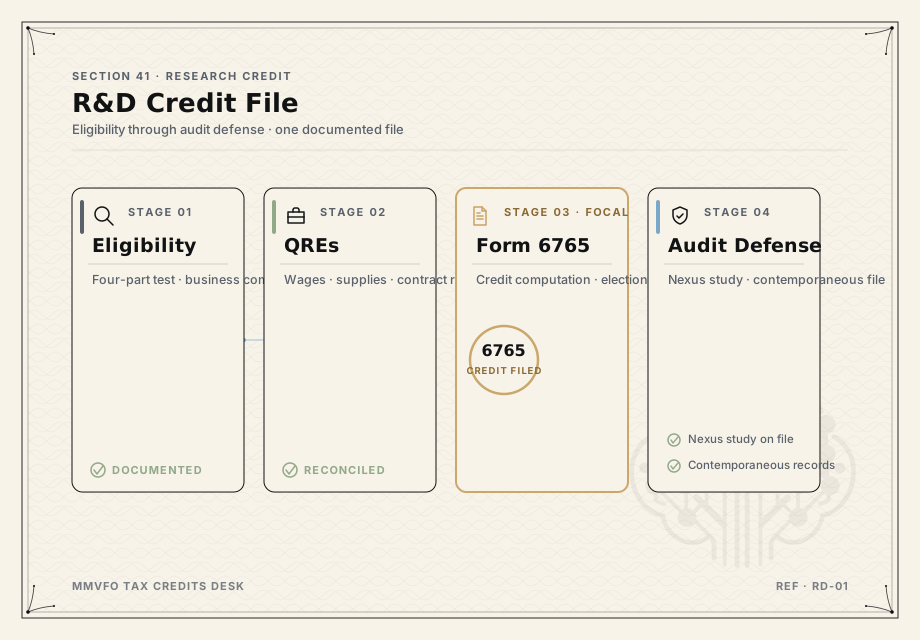
R&D credit work is visualized as a file, not a claim: eligibility, QRE support, Form 6765, and examination readiness.
Who this is for
- Software and technology companies
- Manufacturing and engineering businesses
- Startups evaluating the R&D credit payroll-tax-offset election
- Businesses with R&D or specialty incentive exposure
- Founders and CFOs seeking a defensible credit file
- CPA firms needing specialty R&D co-advisory support
Common problems
- Contingency-fee credit mills sell a claimed savings number. MMVFO builds the eligibility memo, QRE support, and documentation the claim needs to survive examination.
- Project narratives, QRE models, employee allocations, and contractor support are weak.
- Section 174A and Section 280C treatment is disconnected from the credit study.
- The examination file is created after the claim is challenged.
- The return team, study team, and controversy team are not working from the same facts.
How MMVFO helps
- Assess eligibility, activities, documentation, and return integration together.
- Coordinate technical narratives, QRE support, employee and contractor allocation support, payroll-tax-offset review, and examination file preparation.
- Coordinate domestic R&E expensing under Section 174A, foreign R&E treatment, and Section 280C considerations with the return team.
- Build a credit file that can support return preparation, advisor review, and a later tax examination response.
- Use a documentation-first process designed for serious taxpayers, CFOs, CPA firms, and advisor teams.
Section 41 eligibility screen
Each claimed activity should be evaluated under the four-part test before the credit is calculated, documented, or reflected on a return.
Permitted purpose
The work seeks to develop or improve function, performance, reliability, quality, or a similar business-component objective.
Technological in nature
The activity relies on engineering, computer science, physical science, biological science, or similar technical principles.
Technical uncertainty
The work addresses uncertainty about capability, method, or design, not merely routine implementation.
Experimentation
The team evaluates alternatives through a technical process, supported by records that can be reviewed.
The defensible credit file
R&D work should leave behind a file that explains why the claim exists, how the numbers were built, and how the position would be supported if questioned later.
Qualified activity theory
Define business components, technical uncertainty, experimentation, and permitted purpose in plain language tied to the client facts.
QRE support
Connect wages, supplies, contractor costs, allocations, and exclusions to the study and return position.
Project evidence
Document what was attempted, what was uncertain, what changed, and what records support the technical work.
Employee and contractor allocations
Support who performed qualified work, how time or cost was allocated, and where contractor agreements matter.
Section 174A and 280C coordination
Coordinate credit calculations with domestic and foreign R&E treatment, return elections, and preparer review.
Examination readiness
Organize the file so a later information request can be answered from evidence, not memory.
R&D service areas
- Section 41 four-part test
- R&D eligibility by activity and industry
- R&D documentation and project narratives
- Form 6765 readiness
- Section 174A and R&E expense planning
- Section 280C coordination
- Startup payroll-tax offset
- Software development R&D credit
- R&D audit defense
- R&D co-advisory for CPA firms
Section 41 R&D credit framework
Apply the test by business component
The R&D credit is analyzed against qualified research tied to a specific product, process, software item, technique, formula, or invention. Broad innovation labels are not enough; the file should show the facts for each business component.
Tie facts to the legal standard
A support file should map the research purpose, technological uncertainty, alternatives considered, and process of experimentation to the requirements in Section 41 and the regulations.
Connect costs to qualified work
Wages, supplies, contract research, and computer rental or lease costs should be supported by records that explain who did the work, what was tested, how costs were allocated, and what was excluded.
Build for filing and review
The credit file should reconcile to Form 6765, Section 174A or other current research-expense treatment, Section 280C decisions, controlled-group rules, state reporting, and amended-claim procedures where relevant.
Qualified research expense support categories
The claim file should separate each cost category and show the source records, allocation method, and connection to qualified research.
| Category | What to support | Useful records |
|---|---|---|
| Wages | Identify employees performing, directly supervising, or directly supporting qualified services and document the allocation method. | Payroll registers, employee rosters, role summaries, time data, interviews, org charts, project records. |
| Supplies | Show the item, amount, timing, and how tangible property was used in qualified research while excluding capital items and overhead. | Invoices, purchase records, item descriptions, lab or shop usage notes, prototype records. |
| Contract research | Show who performed the work, the taxpayer's rights and financial risk, invoices, scope, and the allowable percentage under Section 41 rules. | Contracts, SOWs, amendments, vendor invoices, deliverables, rights clauses, risk terms. |
| Computer rental or lease costs | Show the amount, usage, and connection to qualified research where the statute and regulations permit inclusion. | Provider invoices, usage reports, project mapping, allocation schedules. |
| Business-component allocation | Assign QRE categories to specific components or support any permitted aggregation consistently with the reporting method. | Component registry, project mapping, Form 6765 workpapers, reviewer notes. |
| Reconciliation support | Tie QRE totals to the ledger, payroll, invoices, trial balance, Form 6765, and return positions. | GL exports, payroll summaries, invoice schedules, return workpapers, review memos. |
Defensible R&D credit file
A serious Section 41 file should be organized so a return preparer, reviewer, or examiner can trace the position from technical facts to QRE support and Form 6765.
- Business component index. List each product, process, software item, technique, formula, or invention evaluated for the claim year.
- Four-part test memos. Tie facts for each included component to permitted purpose, technological uncertainty, experimentation, and qualified research expense treatment.
- Exclusion screening. Document removal of post-commercial-production work, customer adaptation, duplication, surveys or studies, foreign research, funded research, and other excluded activities.
- QRE workpapers. Separate wages, supplies, contract research, and computer rental or lease costs, with allocation methods and source records.
- Technical substantiation. Preserve project plans, design records, tickets, sprint artifacts, lab notes, prototypes, test plans, test results, change logs, and failure analyses.
- Return reconciliation. Tie study amounts to the general ledger, payroll, trial balance, Form 6765, Section 280C treatment, and research-expense workpapers.
- Controlled-group and amendment support. Include required controlled-group attachments and, for amended claims, the refund-claim detail and signed declaration required by current IRS procedures.
Documentation checklist
Use this checklist to organize records before filing, amendment, diligence, or controversy review. Detailed files should be shared only through a secure portal after written scope.
- Legal entity chart and controlled-group analysis.
- Tax-year business component list with unique identifiers.
- Project descriptions, status, and claim-year activity by component.
- Four-part-test narratives, technical uncertainty statements, and hypotheses tested.
- Experimentation evidence, including alternatives, iterations, simulations, prototypes, test cycles, and results.
- Employee roster with titles, departments, qualified-services rationale, payroll registers, wage detail, and allocation methodology.
- Supply invoices, usage notes, and exclusion of capital items, depreciable property, overhead, and indirect costs.
- Contracts, statements of work, invoices, rights terms, and financial-risk terms for contract research.
- General-ledger extracts and QRE tie-outs to the return position.
- Software classification support for internal-use, dual-function, or non-internal-use software where relevant.
- Section 280C election support and research-expense coordination workpapers.
- Form 6765 drafts, attachments, review memo, and current-instruction checklist.
- For amended claims, business components, activities for each component, and total qualified wage, supply, and contract research expenses for the claim year.
Common R&D credit audit and claim risks
These are the gaps MMVFO screens before a claim is filed, amended, relied on in diligence, or defended in examination.
- Using broad department-level narratives instead of business-component analysis.
- Treating all engineering, product, software, or process-improvement work as qualified without exclusion screening.
- Claiming work after commercial production began.
- Including customer-specific adaptation, duplication, surveys, foreign research, funded research, or unsupported internal-use software work.
- Unsupported wage allocations or interviews that do not match payroll, org charts, repositories, tickets, or project records.
- Supply claims that include depreciable property, prototypes without support, general overhead, or indirect costs.
- Contract research claims without adequate contracts, risk-of-loss terms, rights terms, or vendor detail.
- Controlled-group errors, missing attachments, inconsistent methods, or incomplete Section 280C and research-expense coordination.
- Amended claims that omit required business components, research activities, QRE totals, or signed declaration support.
Diagnostic questions
- What was the specific business component being developed or improved?
- What technical uncertainty existed at the start of the work?
- Why could the answer not be determined from existing knowledge, standard practice, or ordinary implementation?
- What alternatives were considered, modeled, simulated, prototyped, or tested?
- What technical criteria were used to evaluate success or failure?
- What changed between early and later versions, and what evidence shows the iteration?
- When did commercial production begin, and what work occurred after that point?
- Was any work performed to adapt an existing product or process for one customer?
- Was any part of the work duplicated from an existing product, process, design, or code base?
- Was any research performed outside the United States or U.S. territory?
- Was any work funded by a customer, grantor, or other third party?
- Which employees directly performed, directly supervised, or directly supported the qualified work?
- What records were created during the project, and where are they retained?
- For software, was the software internal-use, dual-function, or non-internal-use, and what support exists for that classification?
Official source notes
R&D service areas
R&D credit work is shown first because it requires the clearest connection between eligibility, documentation, return treatment, and examination readiness.
R&D Tax Credit Documentation Built for IRS Examination
R&D credit documentation is not a folder of generic project summaries. It is the operating file that connects technical uncertainty, experimentation, business-component nexus, wage allocation, contractor treatment, and return positions.
Request an R&D Credit File Review
Form 6765 Section G Readiness for R&D Credit Filers
Form 6765 Section G turns R&D credit reporting into a business-component exercise. MMVFO helps prepare component registries, research narratives, wage roles, QRE categories, and return workpapers before reporting becomes a scramble.
Start Form 6765 Readiness Review
The Section 41 Four-Part Test for R&D Credit Eligibility
R&D credit eligibility is not determined by job titles, innovation language, or industry labels. Each claimed activity must satisfy the Section 41 four-part test and be tied to a business component.
Map R&D Eligibility
Software Development R&D Credits Built on Specific Project Narratives
Software R&D claims are scrutinized when they describe product roadmaps instead of technical uncertainty. MMVFO focuses credit files on architecture, algorithms, integration constraints, scalability, security, testing, wage nexus, and internal-use software classification.
Review Software R&D Readiness
R&D Payroll Tax Offset Planning for Startups
Pre-profit startups may still create cash value from qualified research through the payroll-tax-offset election. MMVFO helps evaluate qualified small business status, documentation, timely election, and payroll-tax/income-tax coordination.
Review Startup R&D Offset Readiness
Section 174A and Section 280C Coordination for R&D Credit Filers
The R&D credit is not isolated from the rest of the return. Section 174A, foreign R&E tracking, Section 280C election modeling, and amended return procedures can materially affect value and defensibility.
Request Section 174A / 280C ReviewCoordination and compliance posture
Each engagement is scoped in writing. MMVFO coordinates strategy, diagnostics, documentation, and advisory execution; it does not provide insurance implementation, investment advisory services, financial planning, securities-related services, legal services, or other regulated services unless that scope is expressly handled by a properly licensed or registered affiliate, professional, or the client’s existing advisor under appropriate written terms.