
Short answer
What this page answers
International tax compliance starts with a full map of foreign accounts, entities, trusts, investments, owners, income streams, filing history, and penalty-sensitive gaps before forms are prepared or corrected.
Cross-border complexity
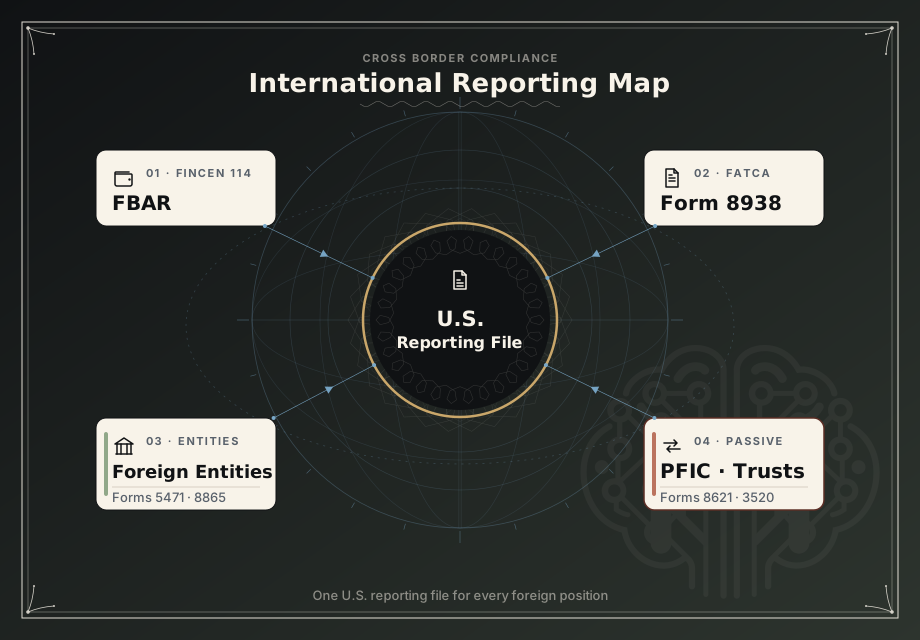
International reporting map
Cross-border work is mapped by accounts, assets, entities, trusts, investments, filing history, and penalty-sensitive facts.
Who this is for
- U.S. persons abroad with complex assets
- Foreign owners investing or operating in the U.S.
- Cross-border founders and executives
- Families with foreign trusts or entities
- Investors with PFIC or foreign account reporting exposure
Common problems
- Foreign accounts and assets are reported inconsistently.
- Forms 5471, 5472, 8865, 8858, 8938, 3520, or 8621 are discovered late.
- Inbound and outbound planning is handled after transactions close.
- International penalties are addressed without a full filing history.
How MMVFO helps
- Map foreign accounts, entities, trusts, investments, owners, and filing obligations.
- Coordinate international compliance with U.S. income tax, estate, and entity planning.
- Identify filing gaps, penalty exposure, reasonable-cause documentation needs, and specialist requirements.
- Support cross-border planning through qualified professionals and affiliates.
Worldwide reporting and overlapping forms
U.S. international tax compliance often involves overlapping reporting regimes. Income tax filing, FBAR, FATCA, foreign entity reporting, foreign trust reporting, PFIC reporting, and CFC-related inclusions can each have separate rules and exposure.
International information reporting map
FinCEN Form 114
Foreign financial account reporting may apply separately from an income tax filing.
Form 8938
Specified foreign financial assets may require reporting with the federal income tax return.
Forms 5471 and 5472
Foreign corporations and foreign-owned U.S. entities can trigger complex owner and transaction reporting.
Form 8865
Foreign partnership ownership or transactions may create additional reporting obligations.
Form 3520
Foreign trusts and certain foreign gifts require careful fact review and documentation.
Form 8621
Foreign pooled investments can create PFIC reporting and tax complexity.
Common triggers
- Foreign bank, brokerage, or mutual fund accounts
- Ownership in foreign corporations, partnerships, or disregarded entities
- Foreign trusts, foreign gifts, or cross-border estate structures
- Foreign life insurance, annuity, hedge fund, or private equity exposure
- Inbound investment into U.S. entities by foreign owners
- U.S. founders, executives, or families moving across borders
Planning events
- Pre-immigration planning before U.S. tax residency begins.
- Expatriation or long-term residency termination planning where exit-tax rules may apply.
- Foreign-owned U.S. entity reporting and related-party transaction review.
- GILTI, Subpart F, transfer pricing, and CFC coordination for business-owning families and founders.
Related service areas
Use these pages to move from a broad service category to a specific planning, filing, defense, or coordination issue before private intake.
FBAR Filing and Foreign Account Reporting for U.S. Persons
FBAR reporting is easy to miss because it is filed with FinCEN and the threshold is aggregate across foreign accounts. MMVFO helps identify filing triggers, coordinate account data, and distinguish FBAR from Form 8938.
Review FBAR Exposure
Form 5471 Reporting for Foreign Corporations and CFCs
Form 5471 is one of the most complex U.S. international information returns. MMVFO helps identify filing categories, coordinate entity data, surface CFC/GILTI issues, and connect with specialists where required.
Review Form 5471 Exposure
Form 8938 FATCA Reporting for Foreign Financial Assets
Form 8938 is often confused with FBAR, but it has different thresholds, asset coverage, and filing mechanics. MMVFO helps build a foreign asset inventory and coordinate reporting with income tax, FBAR, and entity filings.
Map FATCA Reporting Exposure
Form 5472 Reporting for Foreign-Owned U.S. Entities
Foreign-owned U.S. corporations and foreign-owned domestic disregarded entities can have Form 5472 obligations even when the entity seems simple. MMVFO helps identify reportable transactions, entity classification, pro forma Form 1120 needs, and related-party records.
Review Form 5472 Exposure
PFIC and Form 8621 Reporting for Foreign Investments
PFIC exposure can turn an ordinary foreign investment account into a complex U.S. reporting problem. MMVFO helps identify foreign funds and entities that may require Form 8621, specialist calculations, and election analysis.
Review PFIC Exposure
Offshore Disclosure and Streamlined Filing Procedure Triage
Late foreign account, entity, trust, or investment reporting should not be corrected casually. Offshore disclosure and streamlined filing questions require a careful review of filing history, account facts, tax reporting, penalty exposure, and willfulness-sensitive issues.
Request a Private DiagnosticExplore related services
Coordination and compliance posture
Each engagement is scoped in writing. MMVFO coordinates strategy, diagnostics, documentation, and advisory execution; it does not provide insurance implementation, investment advisory services, financial planning, securities-related services, legal services, or other regulated services unless that scope is expressly handled by a properly licensed or registered affiliate, professional, or the client’s existing advisor under appropriate written terms.