
Short answer
What this page answers
Penalty abatement review should identify the penalty type, return series, tax period, notice deadline, AEP or First Time Abate fit, compliance history, reasonable-cause facts, evidence, and response channel before a request is submitted.
Tax Controversy
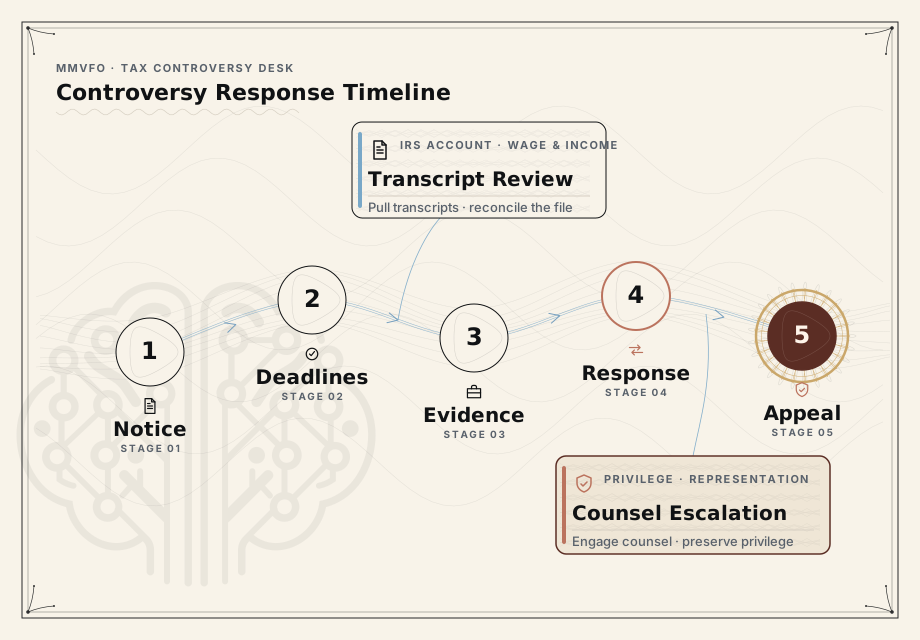
Notice response timeline
Tax controversy work starts with deadlines, transcripts, evidence, response posture, and the right representation lane.
How IRS penalty relief works
MMVFO starts by identifying the notice, penalty category, return type, tax period, assessment status, deadline, payment posture, and transcript history. The right path may be AEP follow-up, FTA, reasonable cause, statutory exception, IRS error correction, appeal review, or counsel-led controversy support.
AEP for eligible current periods
The IRS says Automatic Exemption from Penalty begins in summer 2026 and applies to eligible 2025 tax-year returns, eligible 2026 quarterly returns, and later eligible periods. AEP can prevent assessment of covered failure-to-file, failure-to-pay, and failure-to-deposit penalties when the taxpayer has the required timely compliance history.
FTA for prior periods and non-AEP modules
First Time Abate remains relevant for prior years and periods, and for eligible transition-period accounts not considered for AEP. Unlike AEP, FTA is requested by the taxpayer and generally removes an assessed penalty after IRS account-history review.
Reasonable cause and evidence
Reasonable cause is not a form letter. The IRS says it is determined case by case using all facts and circumstances, and many requests require a clear timeline, ordinary-care-and-prudence explanation, corrective actions, and supporting records.
Before calling, writing, or filing Form 843
A structured review can help determine whether the stronger path is AEP follow-up, FTA, reasonable cause, a narrower penalty-specific argument, appeal preservation, or legal escalation. Actual notices and sensitive records should be reviewed only through secure intake after qualification and written scope.
IRS penalty relief paths
Automatic Exemption from Penalty is automatic only when the published criteria fit
The IRS says AEP begins in summer 2026 and can prevent assessment of certain failure-to-file, failure-to-pay, and failure-to-deposit penalties for eligible 2025 tax-year returns, 2026 quarterly returns, and later eligible periods.
- AEP is applied when an eligible original return completes processing.
- The IRS says no taxpayer action is required when AEP is applied.
- If a notice shows an assessed penalty but the account appears to fit AEP criteria, the IRS instructs taxpayers to contact the agency.
First Time Abate remains a requested administrative waiver
The IRS still describes First Time Abate as an administrative relief path that taxpayers must request. It remains relevant for eligible prior years and periods, and for eligible 2025 annual or 2026 quarterly periods not considered for AEP.
- FTA is generally reviewed from IRS account history.
- The taxpayer does not need to submit a long reasonable-cause narrative for a pure FTA request.
- The penalty is assessed first and then removed if the IRS grants FTA.
Reasonable cause is fact-specific and evidence-driven
The IRS says reasonable cause is determined case by case using all facts and circumstances. For many failure-to-file or failure-to-pay penalties, the taxpayer must show ordinary business care and prudence despite being unable to comply on time.
- The explanation should tie the event, dates, compliance failure, mitigation steps, and documents together.
- Some arguments, such as lack of knowledge or reliance on a preparer, generally do not qualify by themselves.
- Estimated tax penalties and some other penalties may require different relief frameworks.
The notice, period, return series, and penalty category control the path
A penalty review should identify the notice or letter, tax year or quarter, return type, penalty code or category, account history, payment status, and whether the matter is domestic, payroll, information-return, or international reporting related.
- Some requests may be handled by phone using the number on the IRS notice.
- If phone relief is not available, the IRS may require a written request or Form 843 for certain abatement requests.
- Interest tied to an abated penalty is generally reduced or removed when the penalty is reduced or removed.
AEP, FTA, and reasonable-cause comparison
The strongest request depends on the period, return series, penalty category, account history, and available evidence.
| Path | How it works | Action required | Best fit |
|---|---|---|---|
| Automatic Exemption from Penalty (AEP) | For eligible periods and return series, the IRS says it will not assess covered penalties when the taxpayer has the required timely compliance history. | No taxpayer action when the IRS system applies AEP; contact the IRS if a penalty notice appears inconsistent with published criteria. | Eligible 2025 tax-year returns, eligible 2026 quarterly returns, and later eligible periods involving failure to file, failure to pay, or failure to deposit. |
| First Time Abate (FTA) | An administrative waiver requested by the taxpayer and reviewed against IRS compliance-history records. | Contact the IRS by phone or submit a written request or Form 843 where appropriate. | Prior years and periods, and eligible current transition periods that are not considered for AEP. |
| Reasonable cause | A case-specific request based on facts, circumstances, ordinary business care and prudence, and supporting documents. | Prepare the notice details, penalty category, timeline, explanation, corrective actions, and evidence before calling or writing. | Penalty matters where automatic or administrative relief does not apply, or where facts support a documented explanation. |
AEP eligibility map
The IRS administrative relief page lists the return series, periods, and penalty categories that need to be checked before assuming AEP applies.
| Factor | Published IRS position | Review issue |
|---|---|---|
| Return series | Forms 1040, 1065, 1120, 940, 941, 943, 944, 945, and CT-1 are listed for AEP consideration. | Confirm the return series and whether the original return module has completed processing. |
| Relief start periods | AEP relief begins with 2025 tax-year returns and 2026 quarterly returns, and later eligible periods. | Confirm the tax year or quarter before treating AEP as the relevant path. |
| Covered penalties | AEP and FTA cover listed failure-to-file, failure-to-pay, and failure-to-deposit penalties. | Separate information-return, accuracy-related, estimated-tax, international, and other penalties before choosing a relief theory. |
| Compliance history | The same return type must generally have been timely filed for the prior three years, or 12 consecutive quarters for quarterly filers, with limited penalty-history exceptions. | Review transcripts and prior penalty history before promising a likely outcome. |
| Business-return limits | Business taxpayers have additional failure-to-deposit limitations, including prior waiver frequency and EFTPS avoidance issues. | Payroll and deposit cases require a separate business-account review. |
Penalty abatement readiness checklist
A credible review starts with account facts before drafting a narrative or calling the IRS.
- Notice details Notice or letter number, date, response deadline, tax period, assessed or proposed amount, and IRS contact channel.
- Return type Form 1040, 1065, 1120, 940, 941, 943, 944, 945, CT-1, information return, international form, or another return family.
- Penalty category Failure to file, failure to pay, failure to deposit, information return, accuracy-related, estimated tax, FBAR, international reporting, or another category.
- Compliance history Prior three years or 12 quarters for the same return type, including prior penalties, abatements, IRS errors, extensions, payments, and deposit behavior.
- Relief route AEP follow-up, FTA request, reasonable-cause package, statutory exception, IRS error correction, appeal, or counsel-led controversy review.
Reasonable-cause evidence package
The narrative should explain what happened, when it happened, why it prevented compliance, and what the taxpayer did to comply or correct the issue.
- Timeline A dated sequence of the event, missed deadline, discovery, corrective action, and payment or filing steps.
- Supporting records Medical records, disaster documentation, court records, system logs, correspondence, receipts, forms, payment confirmations, or business records.
- Compliance efforts Extensions requested, partial payments, advisor contacts, record-recovery attempts, corrected filings, and steps taken to prevent recurrence.
- Cautions Reliance on a preparer, lack of knowledge, mistakes, oversights, and lack of funds generally need additional facts; they usually do not carry the request by themselves.
Information-return and business penalty framework
Information-return penalties and payroll/deposit penalties can require a different record than individual income-tax penalties.
- Responsible conduct For information returns, review whether the taxpayer acted responsibly before and after the failure, requested extensions when possible, corrected quickly, and tried to prevent the failure.
- Mitigating factors Identify first-time filer facts, good compliance history, IRS actions, agent or third-party actions, record-access issues, and electronic-filing hardships where relevant.
- Payroll and deposits Review the deposit schedule, EFTPS behavior, payment history, prior deposit waivers, and whether the penalty involves failure-to-deposit rules.
Professional review boundary
Penalty relief is a request or account outcome, not a guaranteed result.
- No guarantee Eligibility depends on the penalty, period, account history, facts, documents, authority, IRS processing, and agency review.
- Secure records Actual notices, transcripts, medical records, tax returns, account statements, and privileged communications should move through secure intake only after qualification and written scope.
- Escalation Willfulness, privilege, criminal exposure, Tax Court, FBAR, voluntary disclosure, and legal strategy require qualified counsel.
Diagnostic questions
- What IRS notice or letter did you receive, and what response deadline appears on it?
- Which return type is involved?
- Which tax year or quarter is involved?
- Is the issue late filing, late payment, late deposit, information reporting, accuracy-related, estimated tax, international reporting, or another penalty category?
- Were the same return types timely filed in the prior three years, or 12 consecutive quarters for quarterly filers?
- Were there prior penalties in the lookback period, and were any later removed for reasonable cause or IRS error?
- Does the issue involve an eligible 2025 tax-year return, eligible 2026 quarterly return, or later period where AEP may need to be checked?
- Did illness, disaster, loss of records, civil disturbance, system failure, or another event affect timely compliance?
- What records support the explanation, timeline, and corrective action?
- Has the underlying tax been paid, partially paid, or placed on a payment arrangement?
Official source notes
Scope and professional boundaries
This page is educational and is not tax, legal, accounting, investment, insurance, or other professional advice. Client-specific work requires written scope and review by qualified professionals. Legal representation, privilege, litigation strategy, and regulated services are provided only by properly licensed or registered counsel, affiliates, or other professionals where included in scope. IRS, state, collection, appeals, penalty, and litigation-sensitive matters require deadline control, authorization review, and appropriate representative or counsel involvement. Use public forms only for non-sensitive triage. Do not submit tax returns, notices, account statements, identification documents, privileged communications, or other sensitive records through public forms; secure portal review begins only after qualification and written scope.